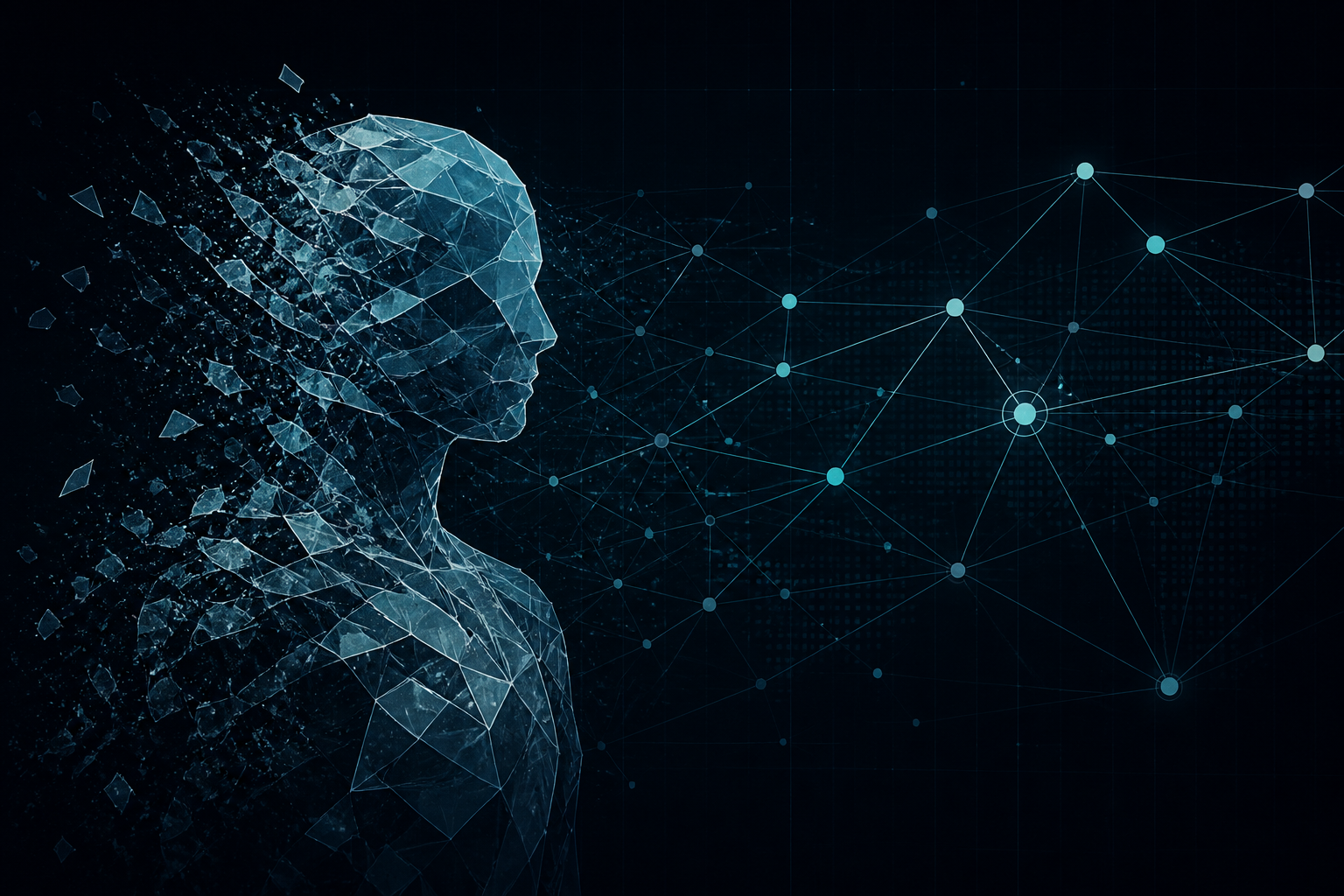
The moment faces became industrial assets
In 2026, identity fraud crossed a quiet threshold. Industry reports now show AI-generated and digitally manipulated documents overtaking physical forgery as a dominant attack method. Deepfake-powered identity fraud is projected to rise nearly fivefold year over year. Document deepfakes — synthetic IDs, licenses, and media submitted as genuine — are among the fastest-growing vectors. Full synthetic identities — personas with no real-world counterpart — already make up a large share of AI fraud attempts.
The technical story is familiar: generative models make faces, voices, and documents cheap to manufacture. Injection attacks feed synthetic streams past camera-based liveness. Selfie-versus-ID checks that once felt like hard gates now look like soft suggestions.
That is the first-order crisis. The second-order crisis is subtler — and more consequential.
First-order thinking: better detectors for better fakes
First-order thinking treats deepfake fraud as an arms race of resemblance. If attackers produce more convincing media, defenders build better media forensics. Blink challenges. Texture analysis. Pixel-blend detection. Liveness that asks you to turn your head.
This is necessary work. It is also incomplete. Every detector that scores "how real does this look?" inherits the same metaphysical assumption that forged the problem: that appearance is the primary criterion of identity. When generative systems can approximate appearance arbitrarily well, resemblance stops being scarce — and therefore stops being informative.
Philosophers have a name for variants of this trap. Descartes worried about an evil demon who could make sensory experience systematically false. Baudrillard wrote of simulacra — copies without originals — that circulate until the distinction between map and territory collapses. Deepfake fraud is those thought experiments with a payment rail attached.
Second-order thinking: what happens after appearance fails
Second-order thinking asks not "how do we spot the fake face?" but "what does trust become when faces are no longer scarce evidence?"
Identity systems historically stacked three kinds of proof:
- What you know — passwords, secrets (easy to steal, easy to phish).
- What you have — devices, tokens, documents (forgeable, clonable, injectable).
- What you are — biometrics and live presence (once expensive to fake; increasingly not).
Synthetic identity fraud attacks the third pillar at industrial scale. The second-order consequence is that organizations must treat biometric match as a claim, not a conclusion. A matching face is evidence that something looked like a person — not that a person was present, continuous with a history, and accountable for a consequence.
Trust, in other words, migrates. It moves from the instantaneous spectacle of a selfie to the slower, harder-to-forge fabric of continuity: accounts with history, devices with consistency, payment rails with friction, and — critically — network provenance that situates a session in a real topology of ISPs, ASNs, regions, and risk.
Where trust migrates when faces become cheap
When visual identity loses scarcity, three properties become more valuable:
1. Continuity over time
A synthetic persona can be perfect for thirty seconds. It is expensive to maintain as a coherent actor across weeks of behavior, devices, addresses, and payment instruments. Fraud industrialized synthetic identities precisely because reuse across platforms amortizes that cost — which is why cross-session and cross-channel continuity checks matter more than any single onboarding selfie.
2. Cost asymmetry
Good defense does not require perfect certainty. It requires making the attacker's marginal cost exceed their expected value. If a forged face is free, raise the price of using it: require out-of-band confirmation, dual approval for high-value actions, delayed settlement for new identities, and step-up friction when multiple weak signals disagree.
3. Independent channels of evidence
The philosophical error of selfie-only KYC was putting all epistemic weight on one sensory channel. Independent evidence — what the payment network knows, what the device attests, what the network path implies — cannot be defeated by improving a single generative model. Corruption of one channel should not collapse the whole judgment.
Network provenance as a ground signal
A face can be synthesized. An IP address cannot invent a country, an ASN, or a hosting facility out of thin air — at least not without borrowing someone else's infrastructure, which itself leaves a trail. Proxies, VPNs, TOR exits, residential bots, and data-center hops are not destiny, but they aresituated. They locate a claim inside a map of how the internet actually routes trust and risk.
This is why IP-level security signals matter more in a deepfake era, not less. When the camera feed can be injected, the network path becomes one of the few remaining channels that is expensive to perfectly launder at scale. A pristine biometric paired with a fresh synthetic document, a hosting-facility IP, a high-anonymity proxy, and impossible geo velocity is not "a user who looks legitimate." It is a story that fails under second-order scrutiny.
IPDrift's security signals — proxy and VPN detection, TOR, crawler classification, threat level, hosting facility — exist for this kind of judgment. They do not replace identity verification. They refuse to let a forged appearance stand alone as proof.
What to do in practice
Treat onboarding and high-risk actions as epistemic problems, not cosmetic ones:
- Demote appearance. Biometric and document matches are inputs to a risk model, never sole pass/fail gates for high-value outcomes.
- Layer independent signals. Combine device integrity, behavioral continuity, payment history, and network provenance (proxy/VPN/TOR, hosting, threat tier, geo consistency).
- Use progressive friction. Soft challenges for mild disagreement; hard blocks and human review when channels conflict sharply.
- Defend the enrollment gate. Injection-aware liveness and out-of-band verification matter most where synthetic identities are born — account creation, not only wire approval.
- Observe before you harden. Log security signals beside verification outcomes. Tune on false positives. Fraud shifts; your thresholds should too.
For teams already using IPDrift, start by joining lookup security fields to signup and login events. Ask simple second-order questions: When a biometric passes, how often is hosting_facility true? How often does threat_level elevate alongside "clean" selfies? Those deltas are where forged appearance hides.
Closing: trust after the mirror breaks
The deepfake era does not mean we abandon faces. It means we stop confusing a mirror for a person. First-order defenses chase better reflections. Second-order defenses rebuild trust on continuity, cost, and independent evidence — including the unglamorous truth of where a request enters the network.
Appearance was never identity. We only noticed when appearance became free.
Bottom line: Synthetic identity fraud forces trust off the face and onto layered provenance. Pair verification with network security signals — or you are defending a mirror while the attacker walks through the door.